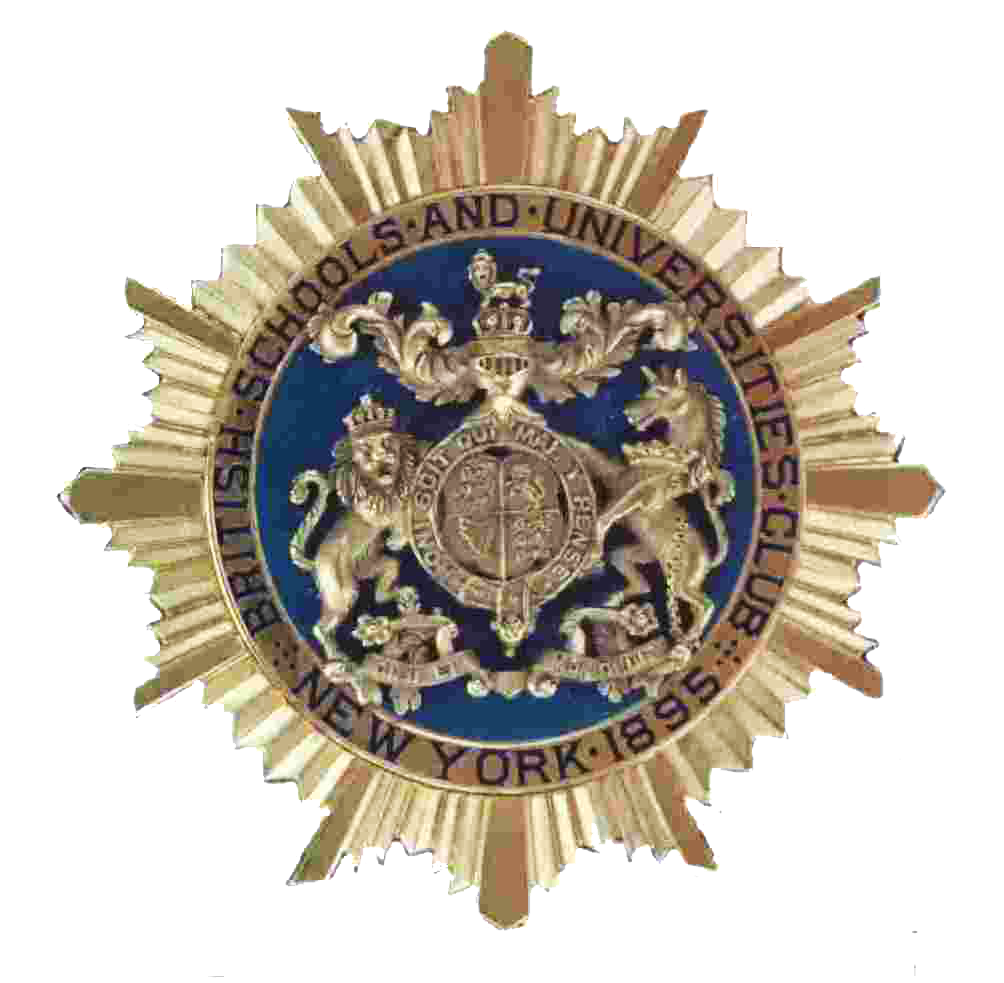
‘HISTORICAL SKETCH’
extracted from the club book - 1929 to 1940 - pages 9 to 15
BRITISH SCHOOLS AND UNIVERSITIES CLUB
RUPERT S. HUGHES
In the year 1895 in the City of Chicago, two men, Vyvyan Harris and R. A. J. Goode, conceived the idea of organizing an Association of British Public School and University graduates within the United States. They held their first meeting on June 17th of that year, and in New York, under the influence of W. A. M. Goode (a brother of R. A. J. Goode), a meeting was held at the offices of the "N. Y. Mercury" in Park Row, for the same purpose. The following men were present: Verner de Guise, Jerome Flannery, W. A. M. Goode, Powell Rees and W. A. Ward, and, possibly, Orton Bradley. On August 6th of the same year a circular was sent out to a number of men whom it was considered would be interested in the Association.
In the minutes of the Chicago group, dated September 23rd, the formation of an organizing committee in New York was duly reported. On October 24th this committee sent out a circular containing more detailed plans of organization as agreed upon by the two committees, inviting prospective members to the first Annual Dinner, which was held at Muschenheim's Arena on November 9th. On the same date a dinner was also held in Chicago and congratulatory telegrams were exchanged between the two groups. Sixty-five attended the dinner in Chicago and forty-two in New York. The next day both dinners and the general plans of the Association were reported at considerable length in the Chicago "Sunday Times-Herald."
Although Chicago had the greater number at their dinner, the group was not destined to survive. When R. A. J. Goode, who was the moving spirit, left the City the local organization petered out.
On November 19th a letter was sent out by the New York group announcing the election of officers and th word "Club" was used in place of "Association." On December 11th the next
dinner was held by the Club at the Holland House.
Others who took an active part in formulating the policy of the Club in its early days were such men as David A. Munro, Editor of the "North American Review"; John Foord, Editor of the
"N. Y. Times"; and Dr. J. A. Irwin.
That the Club had its early struggles is evidenced by the fact that the second Annual Meeting had to be put off because of a lack of a quorum, necessitating a special letter from the Club's first president, Dr. Parker Morgan.
From the start the Club was organized for the purpose of social and intellectual intercourse and good fellowship. The country of a man's birth or his citizenship have never entered into requirements for membership-men born in the United States being particularly welcome.
The first change in those who were eligible for membership is indicated by the omission of the word "Public" from the title of the Club, which took place at an early date. With the advent of the Boer War and the unprecedented help rendered by the various parts of the Empire to the mother country, eligibility to Club membership was made to include schools and universities throughout the Empire as a whole. Finally, in 1933, sons of members whose fathers have been educated in the Empire became eligible for membership, so that to-day the Club stands on a wide basis where men drawn together by the common tie of British education, and their sons, may enjoy the traditions of good fellowship associated therewith.
From the beginning, a series of dinners each season became a fixed policy of the Club, and the birthday of Queen Victoria the occasion of a special function, later to be perpetuated as Empire Day. When King Edward VII came to the throne his birthday was selected as the date of the Annual Dinner, and has so remained ever since. Aside from the Annual Meeting, at which the Club has acted as host to those attending, the evening's proceedings have always commenced with a toast to the President of the United States, the reigning Sovereign, and the Prince of Wales, whenever there has been an incumbent of this high office.
These toasts have been followed by speeches from some outstanding person in the public eye in this country or from overseas. One thinks of such men as Joseph H. Choate, James Bryce, Mark Twain, Lord Balfour, Li Hung Chang, and Dr. Eliot of Harvard. Coupled with the speeches, some professional singer or other musician has entertained the gathering, usually assisted by a talented member or two of the Club. Dr. Christopher Marks, William Owens, and Frank Wright at the piano are not to be forgotten, nor the entertainment given by the redoubtable pair, Doctors Shannon and Freeman, in their renderings of "Father O'Flynn." Expressive of the spirit of these evenings has been the traditional singing of "Auld Lang Syne" as a termination of the evening's festivities.
One of the outstanding dinners the Club has participated in was the function tendered jointly with the Sulgrave Institute and the English Speaking Union to the Prince of Wales on the evening of November 19th, 1919, at the Waldorf Astoria Hotel.
The usual place for the dinners in the earlier days was the Brevoort or the original Delmonico's. More recently the majority of them have been held in the College Room of the Hotel Astor.
During the Great War of 1914-18, an active part in war work was undertaken by the Club, and contributions were made in a fitting manner to the Prince of Wales Fund, the City of Halifax Relief Fund, and the British and Canadian Patriotic Fund. Many members or their sons served with the Allied forces or in some official capacity on one of the Government Boards functioning at the time.
At a dinner on the evening of November 9th, 1921, H.B.M. Ambassador Sir Auckland Geddes unveiled a bronze plaque commemorating the names of those members or their sons who served in the Allied forces or laid down their lives for the cause, which, today, is again so much in jeopardy.
As a result of the great influx of men of British education to New York after the War, the Club grew by leaps and bounds. In 1920, 119 new members were elected and it was decided to increase the Club's facilities. Extensive quarters were taken at the Waldorf-Astoria, and in January, 1921, the Club was incorporated. By 1922 there were 569 members on the Club's rolls. At this time reciprocal courtesies were arranged with the Public Schools Club of London, which are available to this day, making it possible for members of our Club to enjoy its fine facilities on visits to the Old Country. Billiard, golf and bridge tournaments became regular fixtures, and the privileges of the old Staten Island Cricket and Tennis Club were made available to members. On two occasions the ladies were invited to share in the Club's festivities—a dinner dance in 1922 and a supper dance in 1923.
At this time a permanent home for the Club was considered but after careful investigation the idea was abandoned, and in 1925 it went back to its original function as a dinner club, abandoning the extensive quarters in the Waldorf-Astoria. An office for the Secretary, with writing and reading facilities for members, was maintained at this hotel for a short period, after which the headquarters were moved to the Hotel Shelton for a year. From there they were transferred to the Hotel Vanderbilt, where members could receive mail and read their favorite British Weeklies, and where the Secretary and Treasurer could conduct the business of the Club.
In 1936, the Club accepted the invitation of the St. Nicholas Club to share part of their fine quarters on 51st Street but when this Club gave up their building, headquarters were moved to the Park-Chambers Hotel.
The Management of the Club has been vested in a Board of Directors, each member being elected for a term of three years. This Board has met, since its inception, at dinner once a month during the season, and after the affairs of the Club have been settled, the rest of the evening has been spent in the discussion of timely subjects. To those members who have been fortunate enough to be elected from time to time to serve as Directors, through their active interest taken in the Club's functions, these evenings remain as delightful experiences. For many years, during the Vice-Presidency and Presidency of the lately lamented George C. Lewis, these dinners were held in a private room of the Chemists Club, where members of the Board attending enjoyed his epicurean standards, the memory of which will long remain.
Membership in the Club has generally been divided into three classes-resident, non-resident and honorary, with a fast dwindling class of Associate Members, consisting of those still living who founded the Club in 1895 and who have the distinction of paying no dues. The list of Honorary Members has always been a distinguished one, among whom have been the Prince of Wales or other male members of the immediate Royal Family;
Governors-General of Canada; H.B.M. Ambassadors to Washington, and outstanding men in American public life such as Dr. Nicholas Murray Butler and the late Joseph H. Choate.
From time to time the Club has taken part in many public and patriotic functions, as, for example, the memorial services held in honour of Queen Victoria and King Edward VII and more recently, at the Cathedral of St. John the Divine, the service to the late King George. There has also been the unveiling of the portrait of King George VI painted by Mr. Frank Beresford for the 7th Regiment Armory as a gift from His Majesty, which was made possible by the steadfast efforts of Mr. T. E. Ward, the Club's present Honorary Treasurer. Throughout the long history of the Club it has been indebted to H.B.M. Consulate for its advice and co-operation. The consistent attendance of Sir Gerald Campbell at the Directors' Meetings during his term of office as Consul-General will long be appreciated.
Members of the Club, in their official capacity, have, for many years, attended the Annual Dinners of such sister societies as St. George's, St. Andrew's, St. David's, The Canadian, and the English Speaking Union.
The success of the Club's functions have been, to a great extent, due to the untiring work of the Entertainment Committee, and such names as Charles G. Ramsey, Herbert W. Soutar, and the late Charles J. Chapman stand out pre-eminently for their unselfish effort over many years. The Club is greatly indebted to its distinguished past Presidents, among whom was the late Rev. S. Parkes Cadman, D.D., who gave so unstintingly of his time, energy and inspiration during the six years he presided over our activities.
To the Rhodes Scholars who, through the munificence of Cecil Rhodes, have enjoyed the best that British education can offer, the Club has always tendered a particular welcome and opportunity for these men to carry on Rhodes' great ambition of creating an ever closer understanding between the English-speaking peoples.
At a time when this old world is beset as it has never been before, and the ideals, which this country and the British Commonwealth of Nations have played such an important part in fostering, so seriously menaced, the Club looks forward to greater effort in the preservation of these ideals in its own quiet way.